alternative · comparison · tutorial
Free Featurebase Alternative in Next.js: Feedback Boards
Build your own free Featurebase and Canny alternative: feedback boards, voting, statuses, and voter notification emails directly in your database.
Featurebase and Canny promise a customer feedback board in five minutes, with zero code.
Then month six arrives with the invoice. Hosted feedback tools charge a monthly fee that grows with your tier, and your roadmap lives on their subdomain and their pricing page. Check their current prices before you decide.
You can have the same thing inside your own app.
Public boards.
Votes.
Comments.
A roadmap.
In the database you already run.
What a board gives you
A public board turns scattered emails and DMs into one ranked list.
Customers see their request. They see its status. They stop asking whether anyone read it.
You see which asks repeat, which gets the most votes and which can wait.
That ranking is the value. It replaces gut feeling with a count of people who care.
What to do
Create a board. Name it. Open its public page.
Add three requests yourself, so the page never looks empty. Share the link in your next update.
Then keep a rhythm.
Once a week, sort by votes.
Move the top request to planned.
Tell the people who asked.
A board only works as a roadmap if the statuses move.
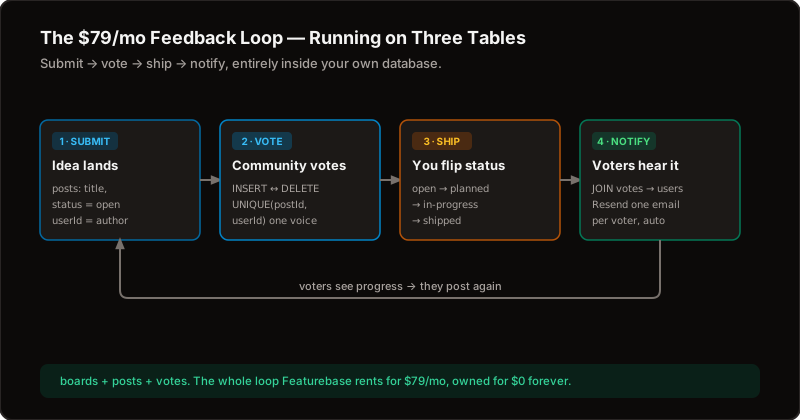
Requests move through four statuses: open, planned, in progress and done.
You can run more than one board.
A board for feature requests.
A board for bugs.
Each gets its own public page.
Manage it from the terminal
bp boards lists, shows, creates, renames and deletes boards.
bp posts lists, shows, creates, changes the status of and deletes posts.
Your coding agent can triage feedback too. It reads the newest requests, marks one as planned and reports what it did. Each command asks for a sign-in limited to what the token allows.
Voting that survives a refresh
Signed-in visitors vote under their account. One vote each.
Anonymous visitors can vote too, limited to one vote per network. That keeps the board open without forcing a sign-up.
It is a deliberate trade. Good enough to rank requests. Not a defense against a determined person with many connections.
Commenting is for members only. There is a sign-up gate between a stranger and your comment section.
The honest gaps
The paid tools are focused products with polish BoringPush does not try to match.
There is no automatic email to voters when a request ships. You can see who voted and write to them yourself.
No AI duplicate detection. No changelog widget. No customer-segment filtering.
For a board, votes and a roadmap for a few hundred users, building it into your app costs nothing extra.
A quick way to decide
| If you need | Pick |
|---|---|
| A public board and roadmap on your own domain | The built-in board |
| Votes and comments in your own database | The built-in board |
| Automatic emails to voters when something ships | A hosted tool, or build it yourself |
| Duplicate detection, changelogs, segments | A hosted tool |
Who it suits
A solo founder or a small team with real users and a short list of requests.
Anyone who wants the board on their own domain, with votes in the same database as their customers.
It is built for a board, votes and a roadmap. Triage workflows across many products are another tool's job.
Your first board in ten minutes
Create it from the dashboard or with bp boards. Give it a name. Open its public page.
Seed it with three well-shaped requests. Empty boards stay empty. Three good examples teach the format without a word of instruction.
Share the link in your next update, and let the first real requests arrive.
Know this first
BoringPush has no email to voters when a request ships. No duplicate detection. No changelog widget.
It is a board, votes and a roadmap. It is not a full feedback suite.
Why BoringPush is the way to do this
Your roadmap, ranked by your customers.
Boards, votes and comments ship inside your app. Four statuses turn it into a public roadmap. bp boards and bp posts run it from the terminal.
In your database. No monthly fee.
FAQ
Is the built-in board really free?
It is part of the kit you buy once, so there is no monthly fee for the board. You pay for hosting you were already paying for.
Can customers vote without an account?
Yes. Anonymous votes are allowed with a limit of one per network. Logged-in visitors vote under their account.
What statuses can a request have?
Open, planned, in progress and done. Change them from the dashboard or with bp posts.
Does it notify voters when I ship?
Not automatically. That is one of the gaps named above. You can see who engaged and write to them yourself.
Can I run separate boards?
Yes. Create as many boards as you need, each with its own public page, from the dashboard or with bp boards.
Can my coding agent manage feedback?
Yes, through the same bp commands, with a sign-in token whose access you control.
Keep reading
- Feedback Board Template for Next.js — the board in more detail
- Free Mixpanel and Google Analytics Alternative — pair feedback with the numbers
- OpenCode SaaS Starter: Stop the Every-Session Redesign — letting agents work the board safely
+ all the boring stuff (analytics, auth, SQLite ↔ Supabase, full marketplace, webhooks)
Command from your phone.
Built so autonomous AI agents build what you want without breaking what's already paying you.
- Built-in analytics — cookie-free mode, $0 forever, no PostHog bill
- SQLite ↔ Supabase: one setting, same field names
- Full digital marketplace & feedback boards included
- 3 payment rails: Stripe, LemonSqueezy & Dodo Payments
- Agent fences: lint gate, read-only data access, auto-rollback
- Ship from your phone via SSH & WireGuard/Tailscale in under a minute
$199
Get BoringPushOne-time payment · Lifetime updates · Unlimited projects.
Keep reading