ai · tutorial · vibe-coding
Why Most Vibe-Coded Projects Fail (8,600 Votes Say Why)
8,600 Redditors dissected vibe-coding failure. The pattern: skipping basics. The fix: verification gates + thin routes. BoringPush take.
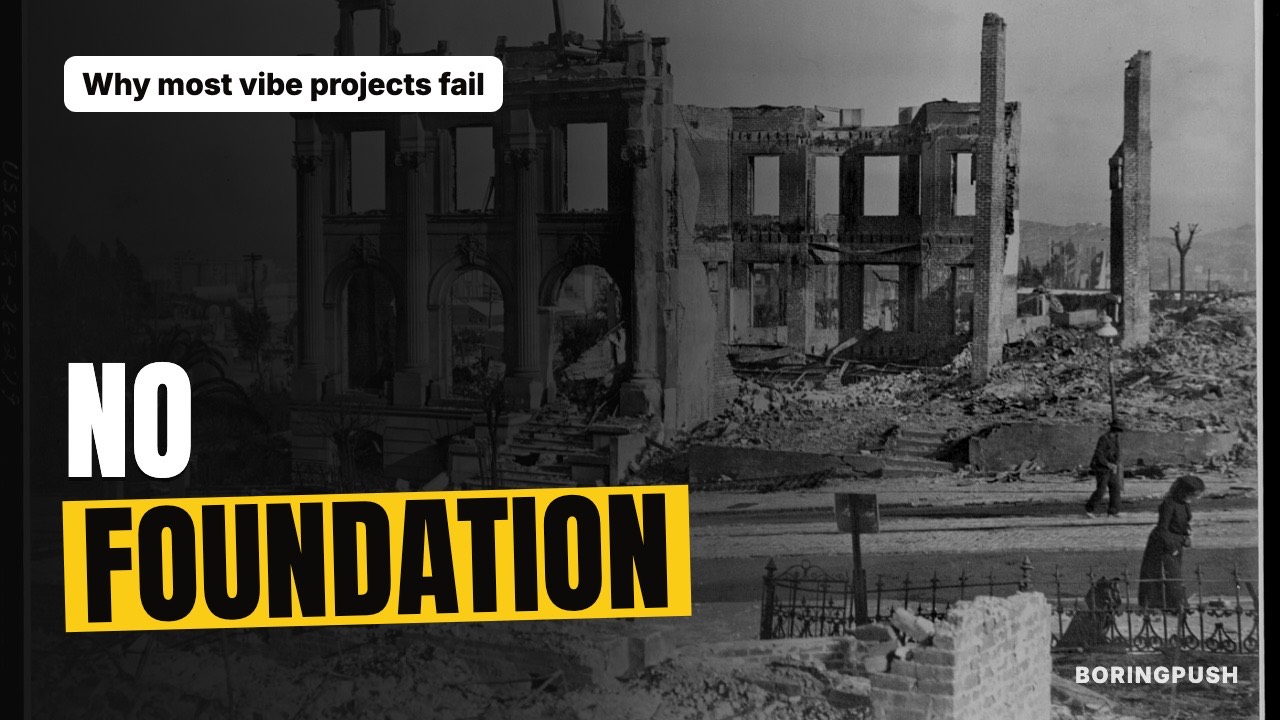
Debated by 8,600 people
The most upvoted vibe-coding post on r/ClaudeAI isn't anti-AI — the top comments are from daily agent users. Their diagnosis stings because it's boring: most vibe projects fail because people skip the basics.
AI writes code fast, but you still need to know what you're building. Marketing, not code, kills the rest — but the code failures share one shape: unreviewed output promoted straight to production.
The research backs the thread. An arXiv study of 1,154 Reddit and HN posts frames AI slop as a tragedy of the commons: individual speed gains billed to reviewers and maintainers as review friction. 67% of developers now debug AI code longer than before. 40% of vibe-built corporate apps expose sensitive data with no auth.
And the failure that should scare founders most is quiet: code that passes lint, looks idiomatic, ships fast — and becomes the vulnerability later.
The built-the-wrong-thing-cleanly thread names the deepest cut: scoped sessions and plan mode produce clean code for wrong requirements. The agent executed perfectly.
Nobody did the product thinking first.
The three disciplines that survive contact with agents
1. Spec before session. One paragraph per feature: what it does, what it must never touch, how you'll verify it. The wrong-thing thread's fix — product step, design step, then task-scoped sessions — is just requirements engineering with the serial numbers filed off. Ten minutes here saves the rewrite.
2. Verify, don't trust. The agent that says "done" while POST returns 500 is the norm, not the exception: agents optimize for producing code, not proving correctness. Every BoringPush agent turn ends at the same gate:
node --check <changed.js>
npm run lint          # zero warnings or it doesn't ship
curl -s localhost:3000/api/<route>   # prove the thing works
3. Thin routes or nothing. A 250-line agent-generated handler is where slop hides: auth skipped, secrets leaked, transactions forgotten. The thin-route law (about 40 lines: validate, check access, make one call, return JSON) makes slop unmergeable — there is simply nowhere for it to hide. Ship from anywhere on this Next.js stack and the same three disciplines guard phone sessions and desktop ones alike, because they live in written rules files, not in anyone's memory.
The rewrite test: spec failure or execution failure?
When a session goes wrong, diagnose before re-prompting — the fix differs completely. Ask: if a senior dev got the exact prompt, would they build the right thing?
Yes → execution failure: tighten scope, shrink context, one task per session. No → spec failure: no amount of prompting saves it, because the requirements were never decided.
The wrong-thing-cleanly builder discovered the expensive version: perfect execution of unwritten requirements, paid for in rewrites.
The practical version takes fifteen minutes and needs no new tools. First, brainstorm the feature out loud with the agent as a companion — argue about what it should NOT do; the exclusions are the spec.
Second, make it sketch the affected screens or API shapes and poke holes. Third, turn the survivors into a task list where each task carries its own mini-spec (inputs, outputs, forbidden files).
Then run one small session per task. Context stays tiny so details stop silently dropping, and each session gets macro intent plus micro detail at once.
Builders who switch to this report the same side effect the thread found: sessions get shorter and rewrites nearly vanish — because the agent was never the bottleneck. The missing requirements were.
What to do Monday morning
Pick your most painful recent agent session and run the post-mortem: spec failure or execution failure? If spec, write the paragraph you wish you'd written first and keep it as a template.
If execution, find where context overflowed — usually one mega-prompt doing three jobs — and split it into three task files. Then add the verification gate to your repo so the next session proves instead of claims.
One morning, one template, one gate: that is the entire difference between the 8,600-vote failure thread and the teams quietly shipping with agents every day.
FAQ
Is vibe coding useless then?
No — it's unmatched for MVPs, internal tools, and prototypes. The thread's level-headed middle: amateurs fail, skilled engineers with verification ship.
Be the second group on purpose.
What's the single highest-leverage fix?
The verification gate. Specs help, thin routes help, but "prove it runs before you claim done" catches every category of failure at once.
How do I review AI code without reading every line?
Read the diff shape, not the lines: files touched (should be few), new dependencies (should be zero unless approved), auth checks present, tests actually asserting behavior. The gate handles syntax; you handle intent.
Do I need to learn to code to vibe-code safely?
You need to learn to specify and verify. The 8,600-vote consensus: product thinking transfers, syntax doesn't have to.
Why does BoringPush claim to be agent-proof?
It doesn't claim magic — it claims guardrails: data-first schema parity across three databases, additive-only migrations, thin routes, zero-warning lint, and skills files agents actually follow. Slop hits the guardrails instead of production.
+ all the boring stuff (analytics, auth, SQLite ↔ Supabase, full marketplace, webhooks)
Command from your phone.
Built so autonomous AI agents build what you want without breaking what's already paying you.
- Built-in analytics — cookie-free mode, $0 forever, no PostHog bill
- SQLite ↔ Supabase: one setting, same field names
- Full digital marketplace & feedback boards included
- 3 payment rails: Stripe, LemonSqueezy & Dodo Payments
- Agent fences: lint gate, read-only data access, auto-rollback
- Ship from your phone via SSH & WireGuard/Tailscale in under a minute
$199
Get BoringPushOne-time payment · Lifetime updates · Unlimited projects.
Keep reading