vercel · pricing · tutorial
v0 Ate $60 in Days: The Fixed-Cost Escape
Usage-priced generation burns credits per prompt with nothing shipped. Cap the experiment, then switch to flat agent sessions. Playbook inside.
Sixty dollars of nothing
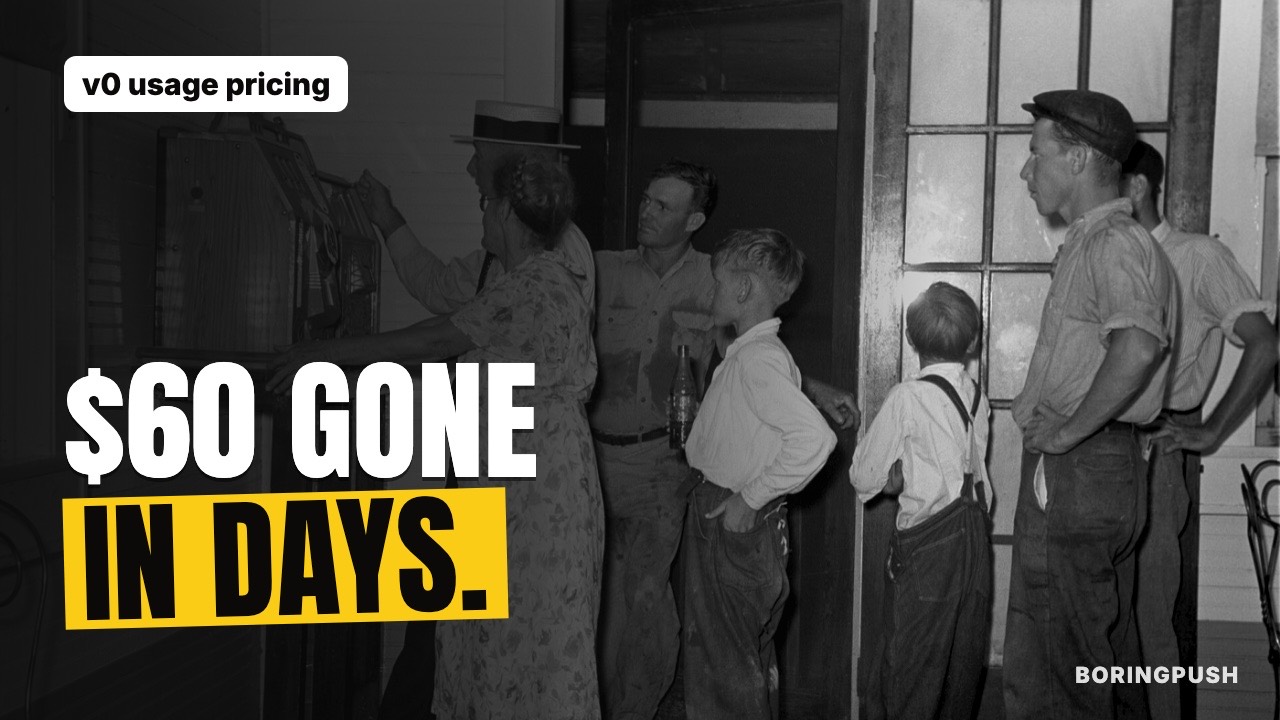
Trying v0 for a landing page hero goes like this. First generation: nice, wrong font. Second: right font, wrong layout. Third through twelfth: converging slowly, each prompt burning credits, each "almost" costing real money. Four days later: $60 spent, one hero section, and the feeling of feeding coins into a slot machine that pays in divs.
The meter runs per attempt, not per outcome. Iterating — the entire design process — is the billable event. Every "hmm, try bolder" has a price tag; every misfire charges full fare.
V0 usage pricing trap isn't fraud. It's selection pressure against the work design actually requires: exploration, mistakes, and the twelfth try that finally lands.
Per-prompt vs flat agent economics
| Week of UI work | v0 per-prompt | Flat agent sessions |
|---|---|---|
| 50 iterations | ~$60 (real receipt shape) | $0 marginal (box + plan) |
| Failed attempts | Billed fully | Free (same session) |
| Exploration | Taxed per idea | Unlimited |
| Production code out | Component snippets | Full repo, gated, deployed |
| Stopping rule | Wallet empties | Task completes |
Three details make per-prompt pricing sting specifically:
- Iteration IS the work. Design converges through variants — nobody lands the hero on prompt one. Pricing attempts taxes the method itself: fewer tries, worse outcomes, higher cost. The meter punishes exactly the behavior quality demands.
- Credits obscure unit costs. Abstract units ("credits," "tokens-as-points") hide per-idea pricing behind cheerful UX — $60 materializes as a top-up prompt, never as a running meter you watch. Opaque units plus iterative work equals surprise totals by construction.
- Snippets aren't systems. v0 outputs components; production needs auth-aware, paywalled, database-backed pages in a repo with conventions. The gap between snippet and system gets rebuilt in flat sessions anyway — paying per-prompt for the sketch plus flat for the system is paying twice for once.
The $900-post proved meters punish growth. This one proves per-prompt meters punish thinking.
V0 as sketchpad, flat as factory
Cap the experiment where it's brilliant, move production where it's flat.
Step 1 — Budget v0 like fireworks: fixed, fun, finite.
v0 rules (mine, enforced by wallet, not willpower):
  $20 experiment cap per component (top-up OFF, alerts ON)
  screenshots out, decisions made, session ends — win or lose
  output = direction (layout, vibe, copy), never production code
Fireworks budgeting works because the cap is structural (top-ups disabled) not aspirational. Twenty dollars buys exploration's joy without funding its drift. Screenshots leave the session; code stays out — v0's output crosses into the repo only as reference images pinned beside the real task.
Step 2 — Build production in flat agent sessions.
# same hero, fenced session: spec (5 min) → branch → build → gate → curl → merge
# cost: $0 marginal (existing plan/box), iterations: unlimited, output: repo-native
# the twelfth try costs patience, not credits — so trying twelve times is correct
Flat sessions invert the economics: exploration becomes free, so quality gets all the iterations it needs. The agent builds inside repo conventions (thin routes, provider verbs, design tokens) — output lands production-shaped, not snippet-shaped. Tweaking is virtuous when tweaks are free.
Step 3 — Bridge the two with screenshots, never code.
1. v0 explores → export screenshots (3 best variants, nothing else)
2. agent builds from screenshots + spec (repo conventions, real data)
3. compare visually → iterate flat (unlimited tries, gated merges)
Screenshots cross the gap because images carry direction without debt — no foreign components, no alien dependencies, no styling-system mismatch. Code crossing would import v0's assumptions into your conventions; images import inspiration only. Direction in, debt never.
That's the setup — sketches metered in dollars, systems built flat.
My UI weeks, metered vs flat
| Landing hero + pricing section | v0-led | Sketch + flat |
|---|---|---|
| Prompt/session spend | ~$60 | ~$12 (capped sketch) |
| Iterations attempted | ~50 (then wallet stopped) | ~80 (task stopped) |
| Production-ready output | Snippets (rebuilt after) | Merged, gated, live |
| Total calendar time | 4 days + rebuild week | 5 days, done |
| Design quality | Good (converged expensively) | Better (more tries, free) |
The catch, said early: v0's generation quality per prompt is genuinely excellent (fast, pretty, surprising) — capped sketching keeps that joy while flat building keeps the economics. BoringPush prices both honestly: pay for sparks, never for factories. Sparks cost dollars; factories cost flat. Confusing the two funds meters with outcomes.
FAQ
Is v0 usage pricing trap avoidable with careful prompting?
Reducible, never avoidable: expert prompts cut iterations (20 instead of 50) but exploration remains metered per attempt — careful just bleeds slower. The cap (not skill) is the control: $20 structural limit bounds any skill level's spend. Prompt well AND cap hard; either alone leaks. Skill reduces waste, caps prevent hemorrhage.
Should v0 output ever enter the repo directly?
As reference screenshots only, never as code: pasted components drag foreign dependencies, alien styling assumptions, and unreviewed patterns into conventions they never met. Rebuild from screenshots inside repo fences (spec → branch → gate) — the twenty minutes feels redundant until the first dependency conflict that never happens. Images inspire; code commits.
How do flat agent sessions handle visual iteration?
Screenshots per iteration (agent renders, you view, prompt deltas) — the loop is visual, the meter is flat. Unlimited tries means honest critique ("bolder," "denser," "try three variants") without mental fare-meters. Visual work thrives on volume; flat pricing funds volume. Iterate like water when water's free.
What about v0 for non-UI work (logic, APIs, schemas)?
Weaker fit: v0 shines at visual generation; logic/schemas/databases play to fenced agent sessions' strengths (repo context, conventions, verification). Use each tool at its peak (v0: pixels, agents: systems), never either for both. Tool-task fit beats tool loyalty — the stack holds many tools, each fenced to its genius.
Can teams share one v0 budget sanely?
With per-person caps inside a team pool (visible balances, no silent top-ups): shared meters need visible gauges or tragedy-of-commons burns the pool by Wednesday. Better: per-seat flat agent plans (unlimited personal iteration) plus one small shared v0 sketch fund. Personal work flat, shared experiments capped and visible. Meters shared blindly always surprise.
When is per-prompt pricing actually the right model?
Rare high-value generations (production logo final, brand illustrations, one-shot assets where attempts stay few and value concentrates). Per-prompt fits lottery-shaped work (few tickets, big prizes); flat fits process-shaped work (many iterations, converging quality). UI development is process, not lottery — price it flat, tip the lottery rarely.
Keep reading
- $900 Vercel Bill? How Surprise Invoices Happen — the meter family this trap belongs to
- Vercel's 100GB Limit Dies on Day 13 (Do This) — the sibling meter, same escape shape
- Antigravity + Next.js: Tame Its 40-File Weekends — flat sessions done right
+ all the boring stuff (analytics, auth, SQLite ↔ Supabase, full marketplace, webhooks)
Command from your phone.
Built so autonomous AI agents build what you want without breaking what's already paying you.
- Built-in analytics — cookie-free mode, $0 forever, no PostHog bill
- SQLite ↔ Supabase: one setting, same field names
- Full digital marketplace & feedback boards included
- 3 payment rails: Stripe, LemonSqueezy & Dodo Payments
- Agent fences: lint gate, read-only data access, auto-rollback
- Ship from your phone via SSH & WireGuard/Tailscale in under a minute
$199
Get BoringPushOne-time payment · Lifetime updates · Unlimited projects.
Keep reading