payments · tutorial · comparison
Dodo vs Stripe: Whose Card Clears in Mumbai?
Selling worldwide plus India? Compare regional methods, MoR taxes, payouts, and fees — then run both behind one interface. Table inside.
When your buyers span continents
Picture a founder in Bengaluru launching globally.
US buyers convert fine.
Indian buyers hit the card wall.
International cards declined.
No UPI.
Prices in dollars.
The Berlin buyer triggers the VAT homework. The payout schedule assumes US banking rhythms.
The checkout works for the founder's own demographic and fails everyone else, one after another.
This is for founders whose buyers span continents.
Coverage first.
Fees second.
Taxes always.
The rails on global-founder axes
| Axis | Stripe | Dodo |
|---|---|---|
| International cards | Excellent | Excellent |
| India local methods, like UPI | Varies, verify current | A native strength |
| Merchant-of-record taxes | No, you file VAT and GST | Yes, they file |
| Payout geography | US-speed rolling | Global scheduling, verify |
| Fee shape | Lower headline percentage | Higher, coverage and tax inside |
| Subscription depth | Best in class | Supported, verify depth |
| One-time and lifetime | Supported | A native sweet spot |
| Docs and ecosystem | Enormous | Focused, growing |
Three things matter more than the fee gap.
Declined buyers never complain. They vanish. Every missing local method is invisible churn, concentrated in the markets you targeted. A gap reads as "no demand" in analytics. That is the most expensive misread in global selling.
Tax homework multiplies per region. India's GST. EU VAT. US state rules. Each is a registration spiral for a solo founder. A merchant of record collapses all three into a fee line.
Payout rails shape cash flow. Rolling payouts fund weekly spend. Scheduled global payouts need a buffer. Mismatching payout rhythm to burn kills more launches than fee percentages do.
Verify coverage and fees before you commit. Both move.
What to do
Decide with your own data.
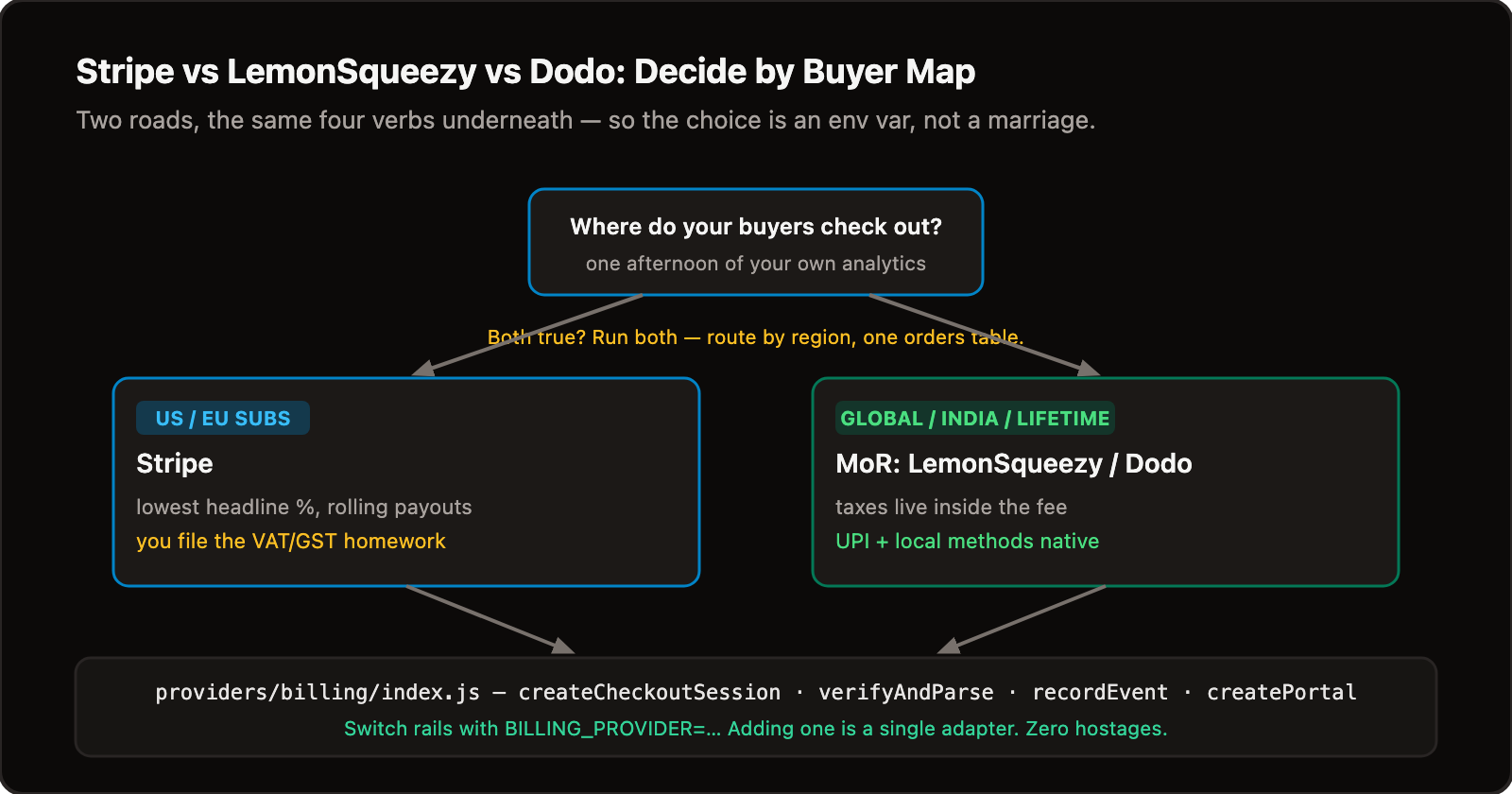
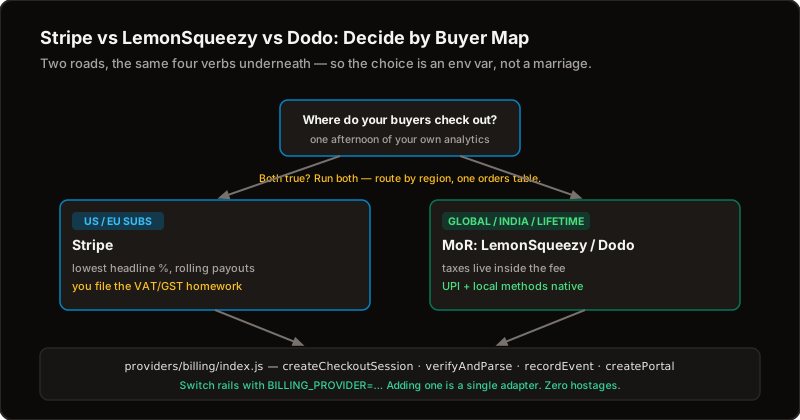
Map buyers before rails. Spend an afternoon on it. Where do visitors come from? The built-in analytics show your top countries. Where do payments fail? Your payment dashboard shows declines by country and method. Do you sell subscriptions or one-time deals?
A rule of thumb: if a quarter or more of your buyers are in India or similar markets, put Dodo in the mix. If you sell US or EU subscriptions, Stripe leads.
It is a heuristic, not law. Adjust it to your margins.
Pick one rail first. One active provider keeps checkout, webhooks and books simple.
Review monthly. Compare each provider's payouts against your orders in the BoringPush dashboard. Ten minutes. It catches fee changes, missed webhooks and payout gaps.
What two rails would cost
| Question | Stripe only | Stripe plus Dodo |
|---|---|---|
| Indian buyer coverage | Card-first checkout | Local methods through Dodo |
| EU VAT and GST paperwork | Yours, unless you add tax tooling | Shared with a merchant of record |
| Dashboards to check | One | Two |
| Switching if wrong | A rewrite elsewhere | A settings change here |
Two rails double the surface you maintain.
Two sets of secrets.
Two webhook setups.
Two monthly reviews.
The honest case for it is invisible churn. Measure that before you decide.
Know this first
BoringPush runs one payment provider at a time. It does not route buyers by region. It does not reconcile payouts for you.
Two providers means two dashboards.
Why BoringPush is the way to do this
Pick the rail your buyers need.
Stripe, LemonSqueezy and Dodo all sit behind one interface. Change the setting. Access works the same for every one.
Choosing is no longer a marriage.
FAQ
Is Dodo vs Stripe for India different from any global comparison?
The shape is global; the stakes are specific to India. UPI is dominant, price sensitivity runs in rupees, GST adds paperwork, and payouts reach Indian banks differently.
Generic comparisons weight US and EU needs most heavily. This one weighs methods first, taxes second and fees third.
Should prices display in INR for Indian buyers?
Local-currency prices usually convert better than dollar prices with mental exchange math. Check what Dodo currently supports for your product type before you promise it, because currency and method coverage change. Whatever you display is a promise, so charge exactly that amount.
How do I handle GST invoices for Indian buyers?
A merchant-of-record provider handles invoicing and compliance on its side, and your order records are the backup. If business buyers need a GSTIN on invoices, confirm current Dodo support first. Invoicing rules shift, and business buyers churn on paperwork friction faster than on price.
What if Stripe adds full UPI parity?
Then re-run your buyer map and consider consolidating. Because the app talks to one interface, consolidating is a settings change. Rails compete, and your architecture should not care who wins.
Do two rails complicate refunds and disputes?
Each provider handles its own refunds and disputes, and both flow into the same order records. Support looks up the order, sees the rail and follows that provider's playbook. Drill a refund on each rail now and then, because untested paths rot.
When should a global founder skip Stripe entirely?
When you have no subscriptions, your buyers skew toward markets with local methods, and merchant-of-record tax coverage matters more than ecosystem depth. Keep the Stripe adapter in the kit regardless. Optionality you keep costs nothing; optionality you rebuild costs a quarter.
Keep reading
- Stripe vs LemonSqueezy vs Dodo: Pick Wrong, Pay for a Year — the three-way comparison this post specializes
- Next.js + Dodo $199 Once: Beat $15/mo Forever — the Dodo adapter in full
- Sell Lifetime Deals on Next.js: $199 Beats $15/mo — the pricing strategy global rails serve
+ all the boring stuff (analytics, auth, SQLite ↔ Supabase, full marketplace, webhooks)
Command from your phone.
Built so autonomous AI agents build what you want without breaking what's already paying you.
- Built-in analytics — cookie-free mode, $0 forever, no PostHog bill
- SQLite ↔ Supabase: one setting, same field names
- Full digital marketplace & feedback boards included
- 3 payment rails: Stripe, LemonSqueezy & Dodo Payments
- Agent fences: lint gate, read-only data access, auto-rollback
- Ship from your phone via SSH & WireGuard/Tailscale in under a minute
$199
Get BoringPushOne-time payment · Lifetime updates · Unlimited projects.
Keep reading